The Ultimate Brihadeshwara Temple Guide: Thanjavur Big Temple History, Architecture, Shrines & Secrets
Introduction to the Brihadeshwara Temple
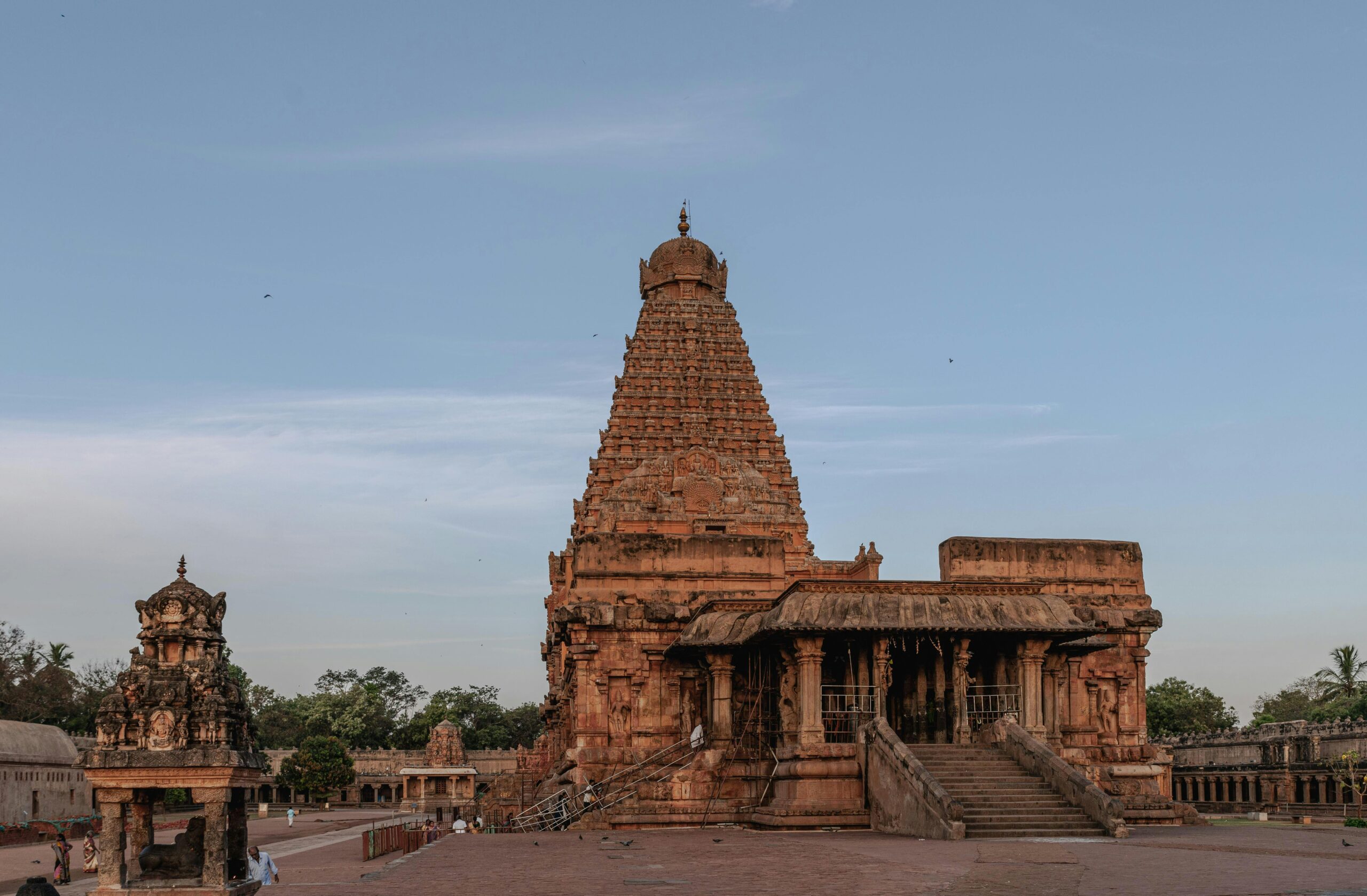
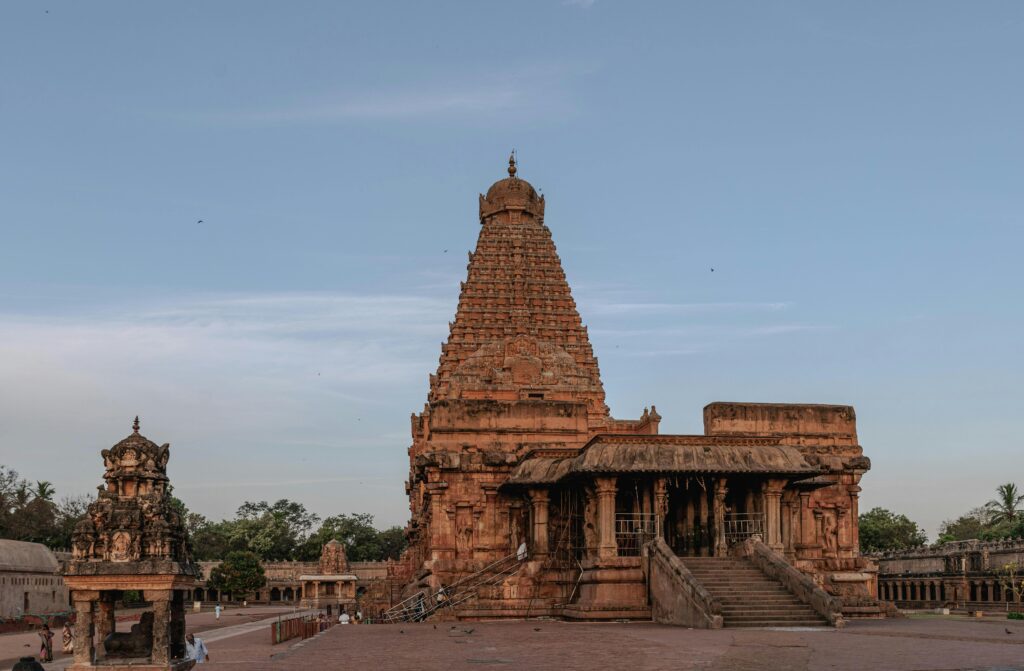
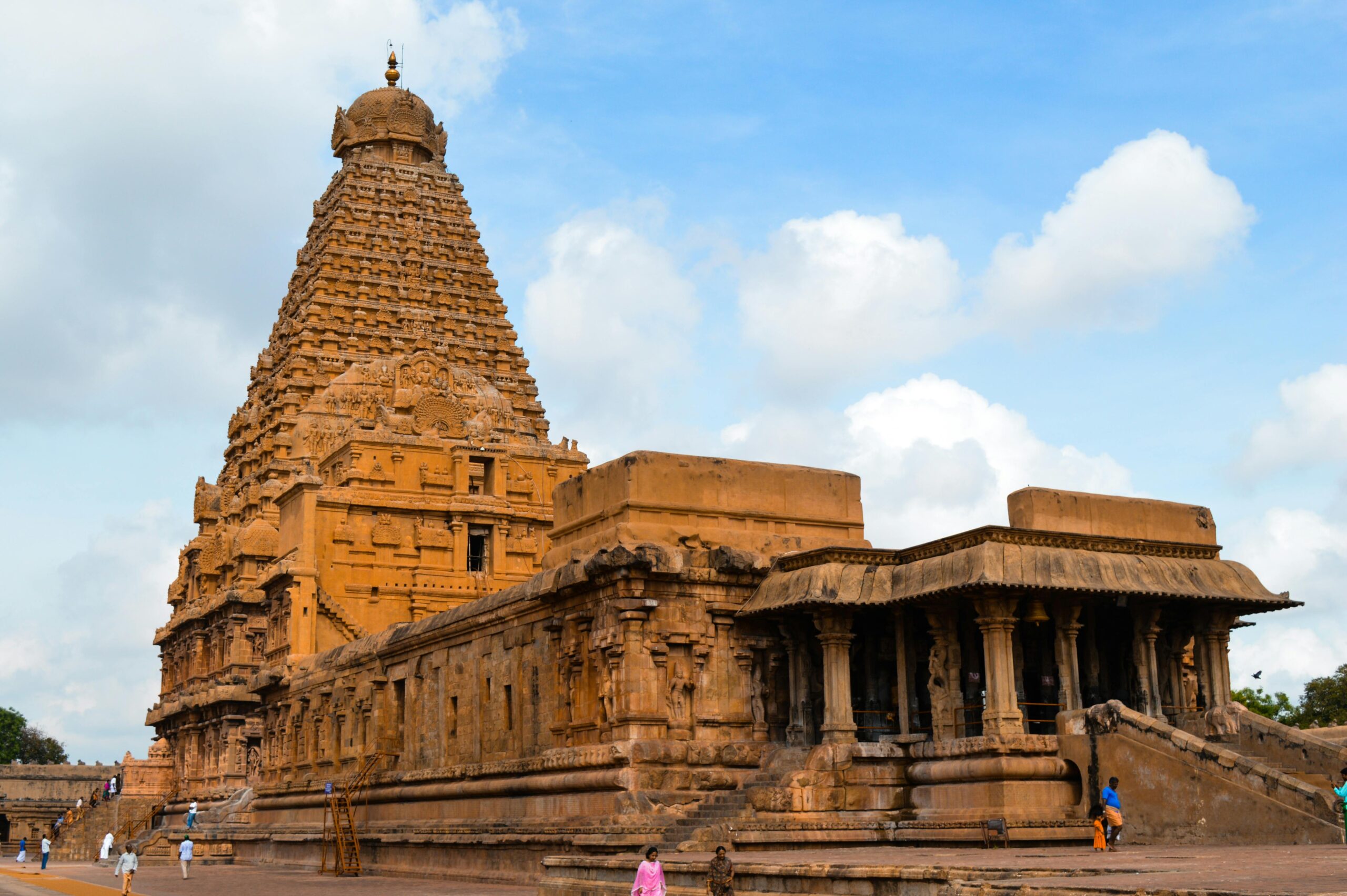
Why is the Brihadeshwara Temple Worldwide Famous?If you are hunting for a travel destination that seamlessly blends raw historical power, jaw-dropping engineering, and deep spiritual vibes, you have landed in the absolute right spot. Tucked away in the bustling, culturally rich city of Thanjavur in Tamil Nadu, the magnificent brihadeshwara temple stands as an ultimate testament to human ambition and cosmic devotion. Locally revered by millions as the Tanjore Big Temple or Thanjai Periya Kovil, this massive architectural masterwork is entirely dedicated to Lord Shiva, the supreme deity of destruction and transformation.
What makes this structure an absolute must-visit asset for any traveler is not just its sheer physical scale, but its unbelievable historical persistence. Unlike many ancient monuments across Europe or Egypt that have crumbled into silent, dead archaeological ruins or transformed into heavily commercialized ticketed museums, this sacred compound remains fully alive. For over one thousand consecutive years, the sacred chants, rhythmic drum beats, and complex Vedic rituals established by medieval emperors have continued inside these stone walls without a single day of interruption.
As you prepare to unpack the absolute depth of this sanctuary, this comprehensive guide will give you direct, practical, and highly curated brihadeshwara temple information. We will dive completely straight into its monumental historical roots, navigate its massive interlocking stone gateways, map out its sacred interior shrines, and deconstruct the mind-boggling engineering secrets that continue to leave top modern Western architects and structural scientists entirely speechless.
Why is the Brihadeshwara Temple Worldwide Famous?
If you start reading standard textbooks about thanjavur temple, you will find a ton of dry dates and technical words. But let’s cut straight to the chase: why does this specific building drive modern engineers, geologists, and global architects absolutely crazy? The worldwide fame of the thanjavur big temple isn’t just hype—it rests on architectural milestones that completely broke all construction rules of the 11th century:
100% Solid Granite, but No Quarries Nearby: The entire temple complex is built out of millions of tons of solid granite rock. Here is the catch: granite is incredibly tough to cut and carve, even with modern steel tools. To make things weirder, there are absolutely no natural granite hills, rock formations, or quarries within a 100-kilometer radius of Thanjavur. Imagine moving a mountain across rivers and plains a thousand years ago without truck trailers or railways.
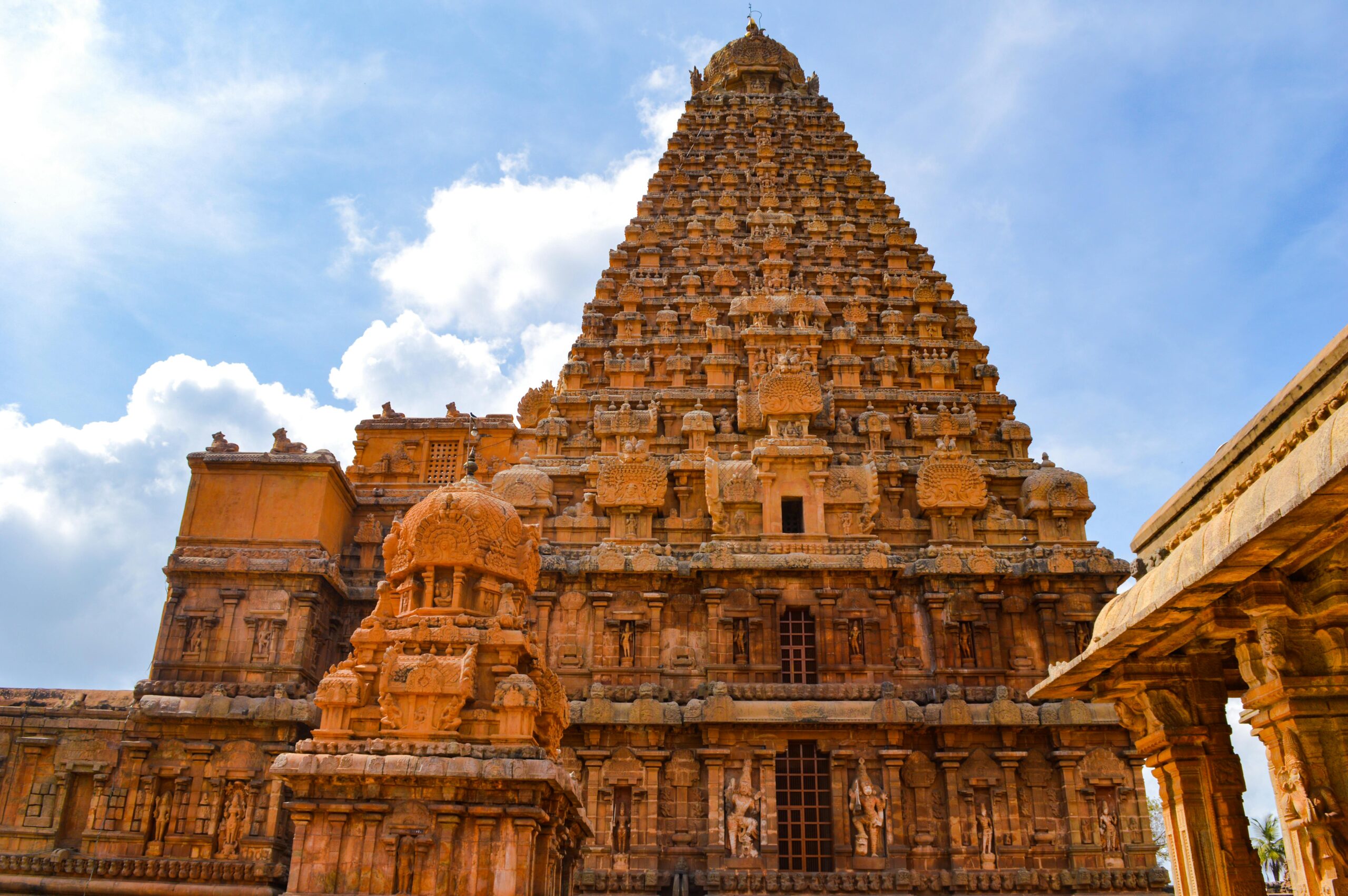
A Tower That Defies Gravity: The main tower rising directly over the innermost sanctum—called the Vimana—stands at a staggering 66 meters (216 feet) high. When the Cholas finished building it, it was literally one of the tallest human-made structures on the planet, competing with the heights of the Egyptian pyramids.
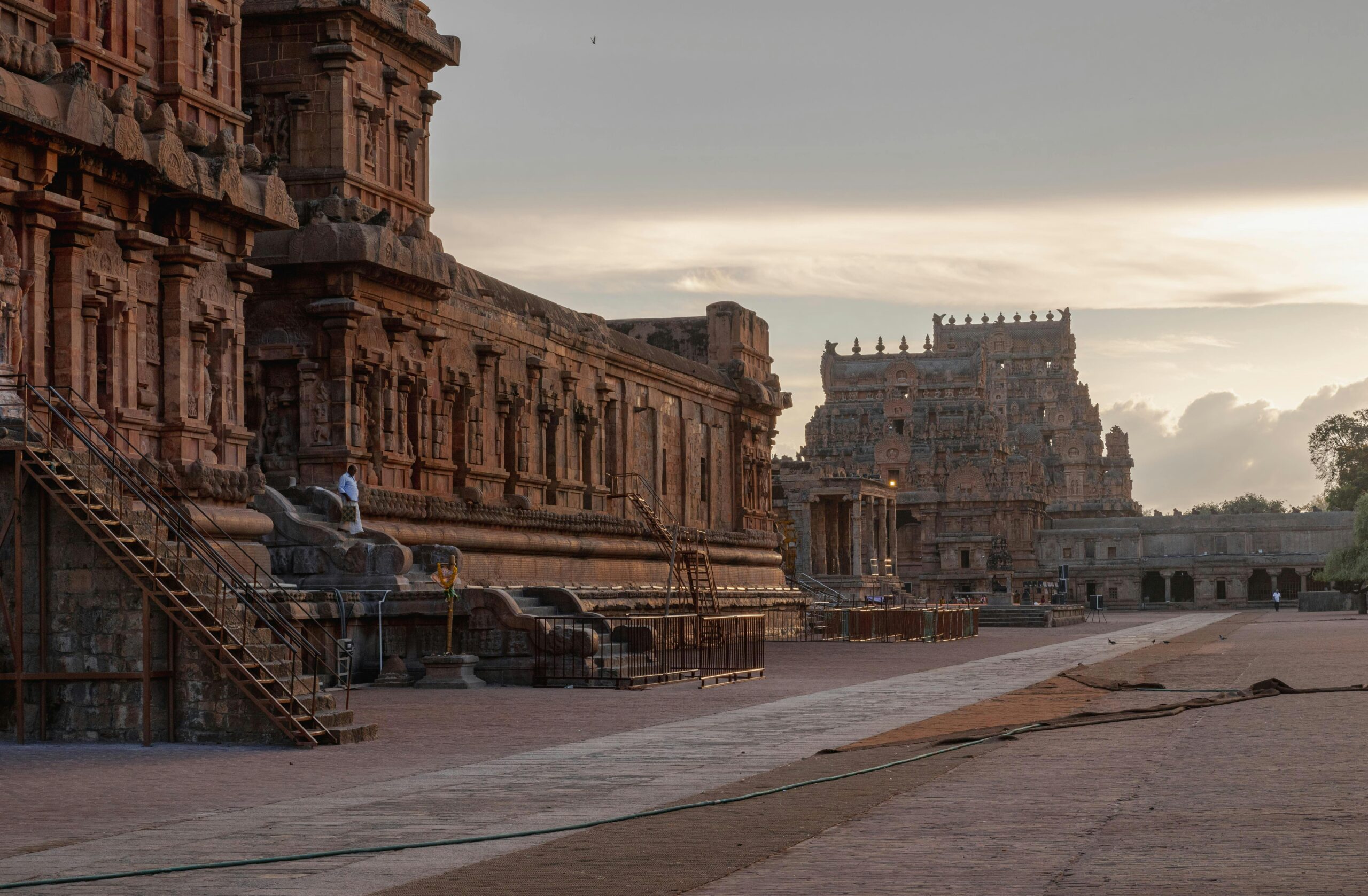
Flipping the Traditional Architecture Rules: Normally, in South Indian temple design, the outside entrance gates (Gopurams) are built incredibly tall, and as you walk inside toward the god, the buildings get smaller. The builders here completely flipped the script. They kept the outer gates elegant but relatively short, and made the inner sanctum’s tower rise up like a giant mountain, creating a heavy optical illusion that makes you feel tiny as you walk closer.
The World’s Biggest Stone Library: This temple is essentially a giant historical archive written in stone. Every single square inch of the granite base walls is covered in clean, beautifully preserved inscriptions in ancient Tamil and Sanskrit. These aren’t just religious chants; they are detailed records of daily life, showing exactly how much the king paid his court dancers, how the local economy ran, and how they managed their massive armies.
Tanjore Temple History: The Golden Age of Raja Raja Chola
To really understand the soul of this place, we have to travel back in time through the pages of tanjore temple history. The story of thanjavur temple history is directly tied to the ultimate peak of the Chola Dynasty. By the start of the 11th century, the Cholas weren’t just a local kingdom anymore. They had built a massive maritime empire, controlling almost the entirety of South India, parts of Sri Lanka, the Maldives, and stretching their trade and cultural influence all the way to Southeast Asia.
The Imperial Architect
If you want to know who built brihadeshwara temple, the credit goes entirely to one legendary emperor: Raja Raja Chola I (originally named Arulmozhi Varman). He was a brilliant military strategist and an administrative genius. Once he established absolute peace and prosperity across his vast empire, he wanted to build a royal shrine that would serve as the ultimate spiritual anchor for his people. Construction started in 1003 AD, and the entire giant complex was fully finished by 1010 AD. Completing a project of this scale in just seven years is a massive masterclass in ancient project management and logistics that puts modern construction timelines to shame.
What makes the brihadeshwara temple built by the Cholas so incredibly special is how transparent the king was. Raja Raja Chola I didn’t try to take all the credit for himself. The inscriptions on the stone walls explicitly name the master architect, Kunjaramallan Raja Raja Perunthachan, alongside the names of individual masons, sculptors, soldiers, temple dancers, and even the palace cooks who worked on the site. Every single donation—whether it was a massive chest of diamonds from the queen or a small copper pot gifted by a temple sweeper—was meticulously carved into the stone. This democratic recording process ensured that the temple belonged to the collective pride of the entire kingdom, not just the royal palace.
Deep Dive into Puranic Legends, Myths, and Vedic Connections
You cannot truly appreciate the thanjavur temple if you only look at its stones and dates. The entire landscape of this shrine is packed with ancient spiritual legends, local ghost stories, and intense Vedic mysticism that give the courtyard its deep, magnetic vibe.
The Legend of Tanjasur and Divine Redemption
According to the Sthala Purana (the ancient local handbook of the temple), this entire region was once controlled by three incredibly cruel demons named Tanjan, Tarakan, and Karalan. These demons had gained massive cosmic powers through severe penances and used their strength to torment local sages, ruin sacred fire rituals, and create absolute chaos across the earth. Unable to take the torture anymore, the rishis prayed desperately to Lord Shiva and Mother Shakti for protection.
Responding to their prayers, Mother Anandavalli, a fierce warrior form of Goddess Durga, came down to earth to destroy the demonic army. She pinned down the chief demon, Tanjan, and dealt him a mortal blow. As he lay dying on the dirt, the sheer energy of the divine presence completely cleared his mind of evil. Repenting for his centuries of cruelty, he bowed before the goddess and asked for one final wish: he wanted his name to live on forever through the land where he finally found spiritual liberation. The goddess smiled and granted his wish. From that exact moment of redemption, the capital city was named Thanjavur.
The Sovereign’s Nightmare and the Saint’s Intervention
There is a fascinating historical folklore that tells a deeper story about who built thanjavur temple. Local legends say that right at the height of his power, Emperor Raja Raja Chola I was suddenly struck down by a mysterious, agonizingly painful illness that left him bedridden. The finest royal doctors from all over the country tried every medicine known to them, but nothing worked. The king was in absolute physical torment.
One night, as he prayed desperately to Lord Shiva, the deity appeared in his dream with a specific command: the king had to find a highly secretive, mystical Siddha saint named Karuvur Devar who was living deep in the nearby forests. The dream revealed that the illness was caused by heavy karmic blockages, and the only way to heal his body was to build a colossal stone mountain-temple for Shiva on the banks of the Vadavaru river.
The king immediately tracked down the elusive, long-haired saint and accepted him as his personal spiritual guru. The moment the foundations of the brihadisvara temple were locked into the earth under the precise astronomical timings calculated by Saint Karuvur Devar, the king’s illness vanished. He walked out of his palace completely healthy and full of life.
Vedic Energy and the Secrets of the Monolithic Lingam
The main deity living inside the dark core of the temple is Lord Brihadeshwara (locally called Peruvudaiyar or Rajarajeswaram Udaiyar). The central Shiva Lingam is an absolute beast, standing nearly 29 feet tall and carved out of a single, continuous block of pitch-black basalt granite.
Ancient texts explain that installing a stone of this massive size creates an incredible amount of raw gravitational and spiritual energy. To keep this energy stable, Saint Karuvur Devar and hundreds of powerful Vedic sages gathered from all over India. They performed intense, high-vibrational fire rituals for days on end.
The craziest part of the story happened during the Ashtabandhana—the ritual where the giant Lingam is permanently glued into its stone base. All the standard chemical and lime mixtures used by the construction teams kept melting away under the heat of the stone. Seeing this, Saint Karuvur Devar used a secret, highly complex herbal paste made from rare medicinal plants, natural tree resins, and pure elemental metals. He literally smeared the paste into the joints with his bare hands while chanting secret root mantras, permanently sealing the massive stone and turning the inner sanctum into a perpetual transmitter of spiritual energy.
Structural Layout Analysis: How Many Buildings and Gateways Exist?
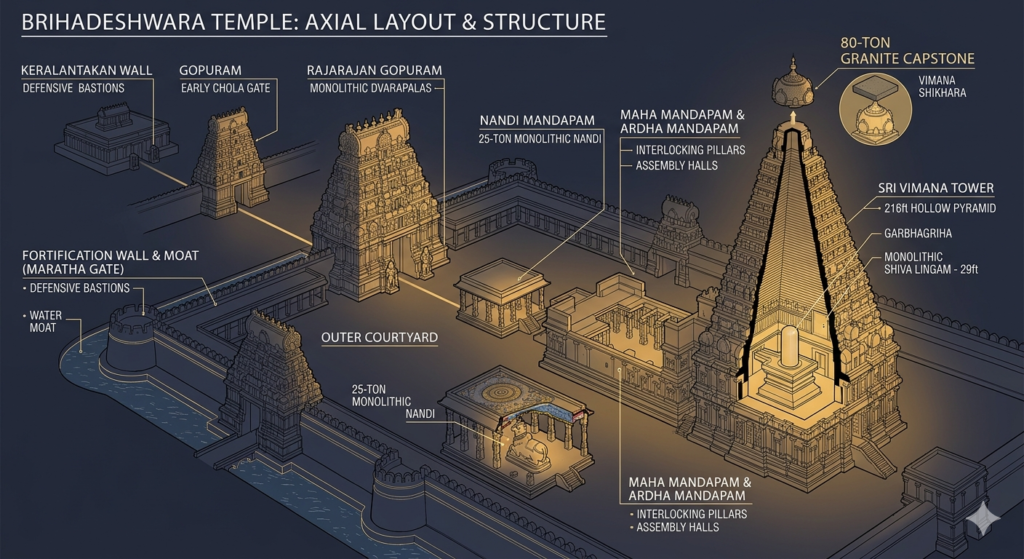
The physical blueprint of the brihadeshwara temple is a massive achievement in ancient geometry, symmetry, and military defense. The entire complex is wrapped in heavy, thick fortification walls and a deep water moat, which were added later by medieval kings to protect the immense temple gold from foreign invaders.
When you walk past the moat into the main courtyard, you will find five distinct architectural buildings and pavilions laid out on a perfectly straight, mathematically precise East-to-West linear line, sitting inside a massive courtyard that stretches 240 meters long and 120 meters wide.
The Architectural Timeline of the Main Axis
| Main Axis Structure Component | Built By / Era | Primary Material Used | Key Architectural Highlight |
| Maratha Gate | Maratha Rulers (17th–18th Century) | Stone & Brick Fortification | Deep defensive bastions, gun slots, and moat integration |
| Keralantakan Gopuram | Raja Raja Chola I (Early 11th Century) | Solid Granite & Stucco Work | Built to celebrate military conquest over the Chera Kingdom |
| Rajarajan Gopuram | Raja Raja Chola I (1010 AD) | Monolithic Granite Sculptures | Guards two multi-ton massive stone Dvarapala gatekeepers |
| Nandi Mandapam | Nayak Kings (Later Renovations) | Dark Single-Block Granite | Houses a 25-ton colossal monolithic Nandi under painted frescoes |
| Maha & Ardha Mandapam | Chola Foundation / Later Additions | Interlocking Granite Columns | Massive public assembly halls leading into the innermost dark core |
| Sri Vimana Tower | Raja Raja Chola I (1003–1010 AD) | 100% Solid Interlocking Granite | 66-meter high stepped pyramid tower with a hollow base |
1. The Defensive Maratha Gate
The first gate you encounter is the outermost Maratha Gate. This structure doesn’t look like a typical temple gate because it was built for pure warfare by the Maratha rulers in the 17th century. It features thick brick bastions, high walls, and narrow slots for gun barrels and cannons, acting as a heavy shield to protect the inner spiritual shrines from invading cavalry charges.
2. The Keralantakan Gopuram
Once you pass the defensive wall, you come face-to-face with the gorgeous Keralantakan Gopuram. This is the first official Chola gateway, built completely out of solid granite at the bottom and decorated with vibrant, colorful sculptures at the top. Raja Raja Chola I built this gate to throw a massive celebration after his army successfully defeated the Chera (Kerala) kingdom, which is why it translates to “the gate of the conqueror of Kerala.”
3. The Rajarajan Gopuram
The final and innermost entrance is the spectacular Rajarajan Gopuram. This gate is wider, shorter, and significantly more aggressive in its design. It is guarded by two jaw-dropping, multi-ton monolithic Dvarapalas (divine gatekeepers). Each of these massive figures is carved out of a single rock, showing a fierce expression with heavy clubs wrapped in giant pythons. The stone carvings around this gate show beautiful, fluid stories of Lord Shiva blessing his devotees, marking the absolute peak of Chola artistic skill.
4. The Monolithic Nandi Mandapam
Stepping out into the grand, open courtyard, the first major pavilion you walk up to is the open-air Nandi Mandapam. This pillared hall houses a mind-boggling monolithic statue of Nandi, Lord Shiva’s sacred bull. Carved out of a single continuous block of dark granite, this statue stands 12 feet high and 19 feet long, weighing an unbelievable 25 tons.
The high ceiling right above the bull is covered in beautiful, centuries-old colorful frescoes from the Nayak era, showing detailed floral patterns and ancient star charts. There is a fun local legend that says the Nandi statue kept growing in size every single year, threatening to crush the roof of its pavilion, until the priests had to drive a sacred metal nail into its back to permanently lock its growth.
5. The Great Assembly Halls (Maha Mandapam & Ardha Mandapam)
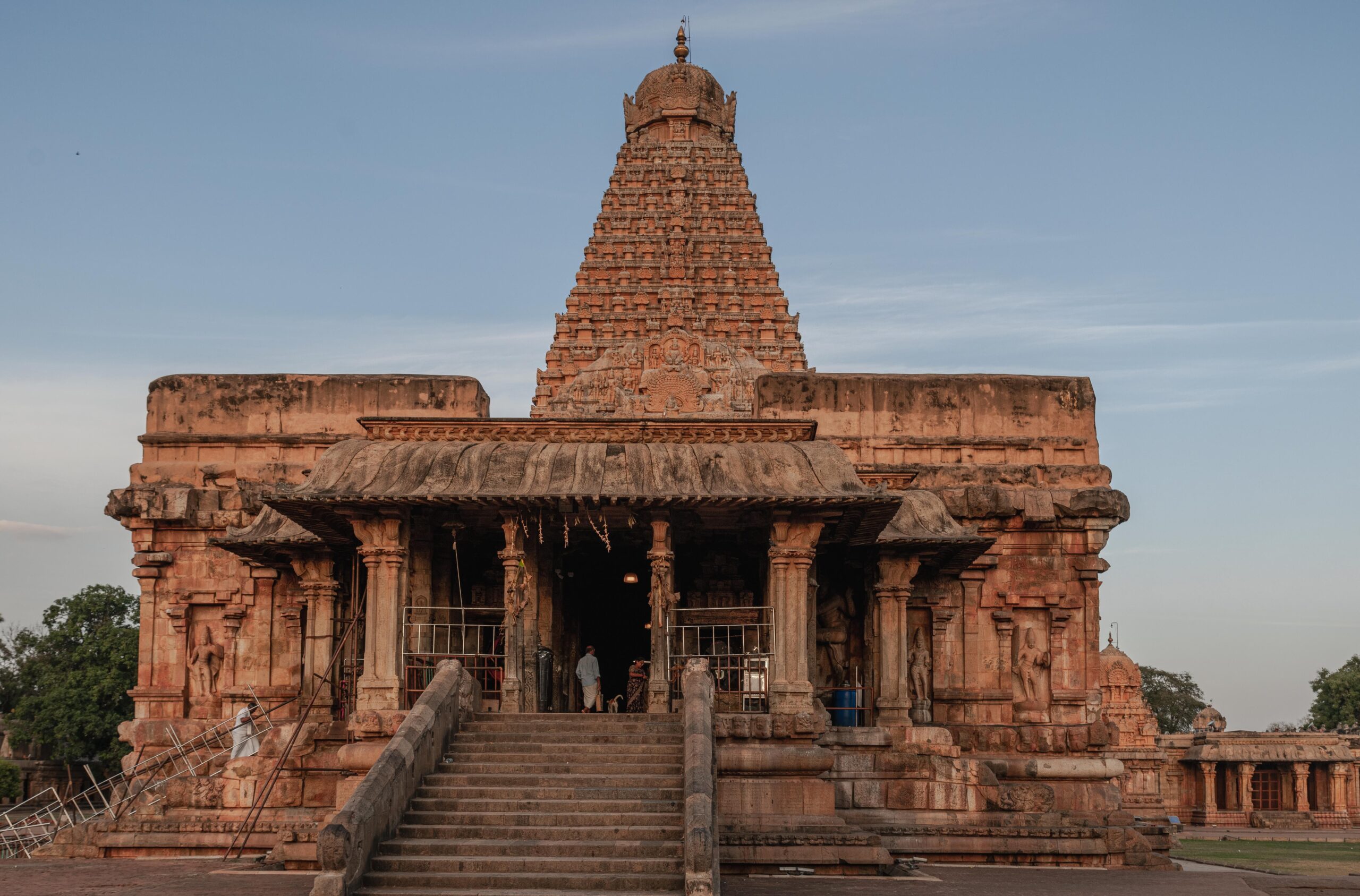
Directly attached to the main tower are the grand public gathering halls. The Maha Mandapam is a giant, dark hall supported by dozens of thick granite pillars where royal meetings, classical music festivals, and state courts were held. This leads directly into the Ardha Mandapam (the half-hall), a quiet, deeply spiritual space lit only by small oil lamps, where the priests stand to organize the sacred offerings and flower garlands before stepping into the main sanctum.
6. The Sri Vimana (The Holy Sanctum Tower)
The final and crowning building of the whole linear line is the incredible Sri Vimana. This is the main tower that houses the 29-foot Shiva Lingam. It rises up in 13 distinct geometric steps like a perfect pyramid. The way the weight of this massive stone tower is distributed is an absolute miracle of ancient physics. The entire multi-ton load pushes straight down into a giant, hollow double-walled foundation system, creating a highly stable base that naturally insulates the main shrine from sudden earth tremors and earthquakes.
The Sacred Pantheon: Detailed Shrines of Gods and Goddesses
While the massive Vimana tower catches your eye from miles away, the vast courtyard of the tanjore big temple is designed to work like a complete spiritual ecosystem. Scattered across the neat stone grounds are several highly important, independent sub-shrines dedicated to the specific gods and goddesses of the Hindu pantheon. Each of these smaller temples has its own unique backstory, architectural style, and timeline:
[North: Goddess Periya Nayaki]
⬏
[East: Nandi] ➔ [Maha Mandapam] ➔ [Garbhagriha: Lord Brihadeshwara] ➔ [West: Sage Karuvurar]
⬎
[South: Lord Ganesha / Murugan]
The Central Sanctum: Lord Brihadeshwara (Peruvudaiyar)
The ultimate focal point of your journey is the two-story core sanctum. The walls of the narrow, secretive walking path running right around the giant 29-foot Shiva Lingam are covered in priceless, long-hidden Chola frescoes. These ancient paintings, discovered by researchers hidden underneath later layers of paint, show hyper-detailed, vivid scenes of Lord Shiva dancing the cosmic dance, the king bowing before his long-haired guru, and celestial angels floating in clouds. The energy inside this dark, stone room, smelling of melted ghee and sandalwood, feels like stepping out of time entirely.
The Shrine of Goddess Periya Nayaki Amman
Sitting directly to the north of the main tower is a large, beautiful independent temple building dedicated to the divine feminine energy. She is worshipped here as Goddess Parvati in her local form, Periya Nayaki (The Great Queen). Interestingly, the original Chola plans did not include a separate giant shrine for the goddess inside the main courtyard. This structure was added later during the Pandya Dynasty in the 13th century. The design shows a beautiful shift in style, featuring slender, delicate pillars, a spacious open porch, and a life-sized stone statue of the Mother Goddess that looks incredibly soft and full of compassion despite being carved from hard rock.
The Shrine of Lord Subrahmanya (Murugan)
Tucked away quietly in the northwest corner of the stone courtyard is the Subrahmanya shrine. Art historians from all over the world consider this specific building an absolute masterpiece of late-medieval Indian stone carving. Built during the Nayak Dynasty in the 16th century, the entire temple building is sculpted to look like a royal stone chariot being pulled by beautifully carved elephants and galloping horses.
The granite pillars here are carved with such unbelievable detail that they look like soft, delicate lace or ivory work rather than cold, solid stone. Every tiny millimeter of the walls features miniature details of warriors on horseback, mythical monsters (Yalis), and battle scenes from the scriptures. The central idol of Lord Murugan features six distinct faces and twelve arms, carved with flawless mathematical precision.
The Shrine of Lord Ganesha (Vinayagar)
Located in the southwest corner of the temple grounds is the dedicated home for the elephant-headed god of new beginnings, Lord Ganesha. This open pavilion houses a beautiful, massive monolithic idol of Ganesha. Historical stone records show that this specific shrine was renovated and the massive idol was set up during the Maratha rule under King Serfoji II. Local devotees always visit this shrine first, ringing the heavy hanging brass bells to clear away obstacles before walking up to the main inner sanctum of Lord Shiva.
The Shrine of Saint Karuvurar
Positioned directly behind the giant main Vimana tower, resting under the cool shade of a sacred tree, is the quiet, deeply mystical shrine of Sage Karuvurar. This spot is incredibly important to the local people. Because the saint was the spiritual mastermind who helped install the massive central Lingam and served as the trusted personal guru to Emperor Raja Raja Chola I, local tradition says that your trip to the thanjavur temple is spiritually incomplete until you stop by his shrine to offer simple country sugar and open coconuts.
Unsolved Engineering Mysteries and Architectural Secrets
The brihadeeswarar temple mystery and the massive list of hidden tanjore temple secrets have kept structural engineers, material scientists, and geologists guessing for generations. Long before anyone invented computers, automated cranes, or industrial explosives, the Chola builders pulled off construction feats that look almost impossible:
The Illusion of the Noon Shadow
One of the most famous talking points among tourists visiting the thanjavur big temple is the claim that the central tower casts absolutely no shadow on the ground at midday. While local tour guides often describe this as pure magic, the reality shows a brilliant display of advanced mathematical design. The architectural steps of the pyramid tower are laid out at a highly calculated geometric angle relative to the movement of the sun. Because of this, during the brightest hours of the day, the shadow cast by the top sections falls entirely inward, catching onto the widening stone steps of the temple’s own base rather than stretching out onto the pedestrian floors. It is a legendary piece of environmental engineering done a thousand years ago.
The 80-Ton Capstone Engineering Puzzle
The absolute highest tip of the 216-foot tower is crowned by a giant, bulbous stone dome known as the Vimana Shikhara or the Capstone. This massive block was cut from a single, continuous piece of solid granite and weighs an estimated 80 tons (80,000 kilograms).
The Big Question: How did ancient builders lift an 80-ton rock to the top of a tower that is as tall as a modern 20-story skyscraper?
The Ramp Theory: Ancient construction sketches and excavations show that Chola engineers built a massive, inclined earthen ramp. This ramp started all the way in a small village called Sarapallam, located nearly 6 kilometers away from the temple site. The ramp went up at an incredibly gentle, slow incline. Using teams of hundreds of strong war elephants, thick ropes made from coconut fiber, and thousands of laborers pulling in perfect synchronization, the 80-ton monolithic block was slowly rolled up the 6-kilometer dirt path over several months until it sat perfectly on top of the tower apex.
[Sarapallam Village] ===(6 KM Earthen Ramp at Gentle Incline)===> [216-Foot Apex of Tower]
The Dry Interlocking System: No Cement Allowed
Perhaps the most incredible fact for modern builders is that the thanjavur temple built by the Cholas does not use a single drop of cement, lime mortar, or binding plaster to hold its core walls together. The entire monument is built using a highly advanced dry interlocking puzzle technique. Every single block of granite was cut with custom-designed slots, ridges, grooves, and tight joints that lock perfectly into the adjacent stones. The structure stands entirely on the natural forces of friction and gravity. This flexible system allows the massive stone tower to slightly shift and breathe during seismic activity, which is the exact reason why the temple has easily survived multiple major earthquakes and devastating regional floods over ten centuries without showing a single structural crack.
The Grand Festivals of Thanjavur Big Temple
Far from being a quiet, dusty historical museum, the big temple thanjavur is a loud, festive center of cultural life where ancient art, music, and spiritual practices are celebrated with massive crowds:
1. Maha Shivaratri: The Cosmic Night of Light
The night of Maha Shivaratri is the most visually stunning event of the year. The entire massive granite courtyard is completely cleared out and illuminated by tens of thousands of traditional clay oil lamps, throwing a beautiful golden glow across the old stone carvings.
The Ritual Bathing (Abhishekam): The celebrations run completely unbroken through the night. The massive 29-foot Shiva Lingam undergoes four separate rounds of grand ritual washings. Tons of fresh milk, pure wild honey, sweet sugarcane juice, aromatic sandalwood paste, and sacred ash are poured over the giant stone deity, while lines of priests chant the ancient Vedic hymns in perfect harmony.
The Natyanjali Festival: At the same time, the open stone courtyard turns into a grand stage for the Natyanjali dance festival. Famous classical dancers travel from every corner of India to perform Bharatanatyam, Kathakali, and Odissi. Dancing under the stars in front of the illuminated Chola tower is considered the ultimate spiritual milestone for any classical artist.
2. Chithirai Brahmotsavam: The 18-Day Mega Carnival
Celebrated during the Tamil month of Chithirai (around April and May), this is the official annual festival of the tanjore big temple, running for 18 straight days.
The Giant Chariot Run (Rathotsavam): The absolute peak of the carnival happens on the ninth day during the grand chariot procession. The beautiful, heavy metal idols of Lord Shiva and Goddess Parvati are moved out of the sanctum and placed inside a massive, multi-tiered wooden chariot with wheels that are taller than a full-grown human. Tens of thousands of pilgrims pack the streets, grabbing onto thick ropes to pull the heavy royal chariot through the historic lanes of Thanjavur in a state of absolute spiritual joy.
3. Emperor Raja Raja Chola’s Sathaya Vizha
Unlike regular religious festivals, this unique annual party is thrown to celebrate the actual historical birthday of the temple’s builder, Emperor Raja Raja Chola I. It happens around October or November, exactly when the moon lines up with the Sathayam birth star of the ancient king. The event brings together government honors and local love. The historical bronze statue of the king is decorated with valuable jewelry and garlands, while the city hosts massive literary debates, historical exhibitions, and music concerts to keep the grand history of the Chola empire fresh for the younger generation.
Essential Visitor Information: Timings, Tickets, and Guidelines
To make sure you have an absolutely perfect trip to see this ancient wonder of South India without any logistical hiccups, keep these up-to-date practical details in mind:
⏱️ Operational Hours & Entry Timings
The temple management runs on a strict daily schedule that is broken down into two main shifts:
Morning Opening Hours: Open from 6:00 AM to 12:30 PM every day.
Afternoon Closing: The main inner sanctum gates and building doors are locked to visitors between 12:30 PM and 4:00 PM so the deities can rest.
Evening Opening Hours: Open from 4:00 PM to 9:00 PM every day.
The Best Time to Visit: To keep your feet safe, try to plan your visit either exactly at the thanjavur temple opening time (6:00 AM) or late in the evening after 5:30 PM. Because the temple requires all visitors to completely remove their shoes before walking into the stone courtyard, the solid granite floor tiles absorb the direct sun and become incredibly hot during the afternoon, making it very painful to walk across the open compound.
🎫 Ticket Pricing & Admission Fees
General Entry: Walking into the main courtyard, exploring the sub-shrines, and getting a standard view (Darshan) of the main 29-foot Shiva Lingam is 100% FREE for both local Indian citizens and international travelers. There is no entrance fee.
Special Darshan Fast Pass: On heavily crowded days like festival nights or Mondays, the queue lines can get massive. The temple runs a special fast-track lane, and you can buy a ticket for this expedited line at the indoor counter for a small fee of ₹20 to ₹50.
F.A.Q.
The main structural blueprint features five distinct buildings set up on a straight East-to-West line: the defensive Maratha Gate, the Keralantakan Gopuram, the Rajarajan Gopuram, the open-air Nandi Mandapam, the large public assembly halls (Maha and Ardha Mandapams), and the final towering Sri Vimana pyramid holding the inner sanctum.
Aside from the central home of Lord Brihadeshwara (Shiva), the stone courtyard holds four major independent shrines: the shrine of Goddess Periya Nayaki Amman, the highly detailed chariot-styled shrine of Lord Subrahmanya (Murugan), the shrine of Lord Ganesha, and the historical spiritual shrine for the royal guru, Sage Karuvurar.
Granite is one of the hardest geological rocks on the planet, requiring immense physical force and specialized tools to cut. To make things more complex, there are absolutely no natural granite hills or stone quarries anywhere within a 100-kilometer radius of Thanjavur city, meaning millions of tons of stone had to be dragged over massive distances using wooden river rafts and elephant lines.
Yes, the temple strictly runs on a traditional dress code. Men are expected to wear traditional dhotis, veshtis, kurtas, or formal full-length trousers. Women must wear traditional sarees, salwar suits, or full-length Indian dresses. Modern western clothes like short skirts, distressed or ripped jeans, sleeveless tops, and shorts are strictly banned from entering the sacred premises.
The temple sits right in the middle of Thanjavur city in Tamil Nadu, India. The closest airport is Tiruchirappalli (Trichy) International Airport, which is about 58 kilometers away. Thanjavur Junction is a major railway station that is directly connected via regular express trains to major cities like Chennai, Bangalore, and Madurai.
Recent Post
-
 Kailasa Temple Ellora: History, Mystery & Visitor Guide
 -
 The Ultimate Brihadeshwara Temple Guide: Thanjavur Big Temple History, Architecture, Shrines & Secrets
 -
 Red Fort Lal Qila: The Ultimate Guide to Delhi's Historic Heart
 -
 Kamakhya Temple Guide: History, Festivals,& Booking Tips
 -
 Manikaran Sahib Himachal Pradesh:
 -
 Ratneshwar Mahadev Temple Varanasi
 -
Kashi Varanasi Travel Guide
-
Kaal Bhairav Temple History & Origin
-
 Golden Temple Amritsar 2025 – History, Sunrise Tips, Langar & Festivals
 -
Jaipur, The Pink City: A Heartfelt Journey into Rajasthan’s Royal Gem